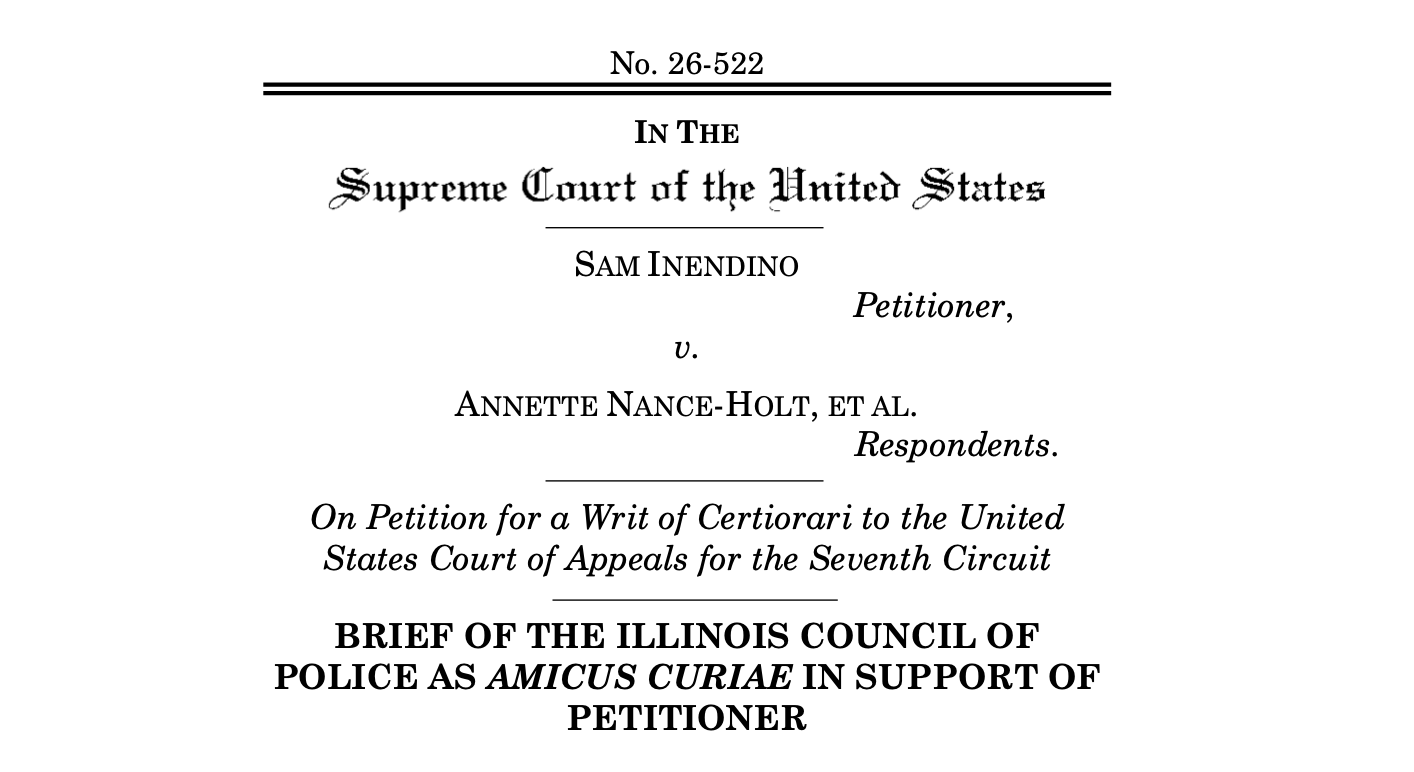
On November 6, 2026, the Illinois Council of Police (ICOPs) filed an amicus curiae brief in the U.S. Supreme Court in Inendino v. Nance-Holt, No. 26-522. The brief supports the petition asking the Court to review a Seventh Circuit decision that lets public employers fire first responders over off-duty speech without proof of any actual harm.
ICOPs President Alexander M. Dunn served as co-counsel for ICOPs on the brief, alongside counsel of record Sam Spiegelman of Spiegelman Law Group.
The case
The City of Chicago fired a Chicago Fire Department firefighter in June 2021 over comments he posted on Facebook while off duty. The investigation began in October 2019 after two unidentified members of the public complained to the City’s Office of Inspector General. The City terminated him roughly twenty months later.
The Seventh Circuit found that the City offered no evidence of any disruption, or even a reasonable threat of disruption, to its operations. It upheld the firing anyway, on the theory that the posts eroded the public’s trust in the department. There was no evidence that anyone in the community he served had ever seen them.
Why it matters to ICOPs members
ICOPs isn’t defending what the firefighter posted. Our concern is the standard, because it applies to every police officer, firefighter, and public safety employee who speaks out about something they care about.
Under Garcetti v. Ceballos, what officers say as part of their official duties gets no First Amendment protection. That leaves off-duty speech as the main way officers can speak their minds about their departments or anything else.
That speech is also how unions do their work. Members and union leaders regularly criticize staffing levels, overtime, deployment, and discipline, usually off duty and under their own names. The “public trust” language the City relied on is standard in police and fire social media policies across the country. If a prediction that speech might undermine public trust is enough to fire someone, nearly any public criticism by an officer or a union could lead to being fired
What the brief argues
- The Seventh Circuit skipped the evidence its own precedent requires. Every case the court relied on had some record of how the public or coworkers actually reacted. Here, the investigation catalogued what the firefighter said but never asked whether anyone in the community had seen it.
- Off-duty speech is the main channel officers have left. A “public trust” rule applied without evidence invites selective enforcement against officers and unions who criticize their departments.
- Public trust can be measured, so agencies should have to measure it. Departments already survey their communities and track complaints, and Chicago publishes trust scores for its police districts. Several states also bar discipline when an investigation drags on too long, as this one did for twenty months.
What happens next
The Supreme Court will decide whether to take the case. If it grants review, the case will be briefed and argued on the merits. If it denies review, the Seventh Circuit’s decision stands in Illinois, Indiana, and Wisconsin.
In the meantime, members should know their department’s social media and off-duty conduct policies. If you are contacted about anything you posted, reach out to your ICOPs representative before you give any statement or sit for an interview.